- SoftICE is a kernel mode debugger for Microsoft Windows. Crucially, it is designed to run underneath Windows such that the operating system is unaware of its presence.
- Unlike an application debugger, SoftICE is capable of suspending all operations in Windows when instructed. For driver debugging this is critical due to how hardware is accessed and the kernel of the operating system functions.
- Because of its low-level capabilities, SoftICE is also popular as a software cracking tool.
- Microsoft offers two kernel-mode debuggers, WinDbg and KD, for no charge.
- However, the full capabilities of WinDbg and KD are available only when two interlinked computers are used.
- SoftICE therefore is an exceptionally useful tool for difficult driver related development.
- The last released version was for Windows XP. Newer versions of Windows are seemingly unsupported as the tool is no longer listed on Compuware's website.
- A commercial kernel-level debugger called Syser claims to continue where SoftICE left off.
A shareware but free to use OllyDbg is a 32-bit assembler level debugger from Oleh Yuschuk. However, it can only be used for user-mode debugging.

CyberOxen -> Plough Your Way Through Cyber Haze
Saturday, December 28, 2013
Introduction to SoftICE

Monday, December 9, 2013
Regular Testing Essential to Stop Hacker Access
- RATs, or Remote Access Trojans (aka Remote Administration Tools), can give hackers total remote control of any compromised system(s). Once this type of malware payload is successfully delivered, through a phishing email, USB delivery or a malicious site, a hacker can easily get up to all kinds of costly mischief.
- This week, reports surfaced that a banking Trojan employing RAT technology known as Neverquest is poised to explode in the coming months.
- What do RATs do?
- “Put simply, a RAT is malware that gives criminals a backdoor to the infected system.
- Once a RAT payload has been delivered, a hacker will have all the access and privileges to everything on the system or device the user does.
- Most APTs (Advanced Persistent Threats) employ some kind of RAT technology because of the absolute power it gives an attacker to do basically whatever they want.
Saturday, December 7, 2013
Huawei security centre in UK gets security clearance
- Huawei supplies software and equipment which channels phone calls and data around Britain and has found itself at the centre of a debate, particularly in the United States, over whether it is a risk for governments to allow foreign suppliers access to their networks
- Britain will clear Chinese telecoms equipment firm Huawei to run a UK-based cyber security centre if it agrees to tighter rules to allay spying and hacking fears, a person familiar with the matter said.
- Check detailed news at http://articles.timesofindia.indiatimes.com/2013-12-05/hardware/44806476_1_potential-chinese-state-influence-huawei-cyber-security.
2M Facebook, Gmail, Twitter Passwords Stolen in Massive Hack
- Hackers have stolen usernames and passwords for nearly two million accounts at Facebook, Google, Twitter, Yahoo and others, according to a report released this week.
- The massive data breach was a result of keylogging software maliciously installed on an untold number of computers around the world, researchers at cybersecurity firm Trustwave said.
- The virus was capturing login credentials for key websites over the past month and sending those usernames and passwords to a server controlled by the hackers
- On Nov. 24, Trustwave researchers tracked that server, located in the
Netherlands. They discovered compromised credentials for 93,000
websites, including:
318,000 Facebook accounts
70,000 Gmail, Google+ and YouTube accounts 60,000 Yahoo accounts 22,000 Twitter accounts 9,000 Odnoklassniki accounts (a Russian social network) 8,000 ADP.accounts 8,000 LinkedIn accounts - http://www.8newsnow.com/story/24135669/2-million-facebook-gmail-twitter-passwords-stolen-in-massive-hack
Friday, December 6, 2013
Microsoft Beefs Up Encryption After NSA Spying Reports
- In response to reports that the feds are spying on tech firms' data as it moves between servers, Microsoft today pledged to step up encryption across its services.
- If true, NSA spying could "seriously undermine confidence in the security and privacy of online communications," Microsoft's general counsel, Brad Smith, said in a blog post.
- Smith said Office 365 and Outlook.com customer content is already encrypted when traveling between customers and Microsoft, while most Office 365 workloads as well as Windows Azure storage are now encrypted in transit between data centers.
- The NSA denied those allegations. "NSA is a foreign intelligence agency. And we're focused on discovering and developing intelligence about valid foreign intelligence targets only."
- Read more at ..http://www.pcmag.com/article2/0,2817,2427962,00.asp?mailingID=4A8C526FE94DD7A9EACC9565528CC0A8
Sunday, December 1, 2013
The Estonian Cyberwar and Its Implications for U.S. National Security
On April 26, 2007, the small Baltic state of Estonia experienced the first wave of denial-of-service (DoS) attacks. Accompanied by riots in the streets, these cyberattacks were launched as a protest against the Estonian government’s removal of the Bronze Soldier monument in Tallinn, a Soviet war monument erected in 1947. These attacks targeted prominent government websites along with the websites of banks, universities, and Estonian newspapers. After three weeks, the attacks ceased as suddenly as they had begun, but not before the Estonian government undertook measures to block all international web traffic, effectively shutting off the “most wired country in Europe” from the rest of the world.
Forensic analysis by US for future defense
http://www.iar-gwu.org/node/65
Forensic analysis by US for future defense
http://www.iar-gwu.org/node/65
Estonia’s experience in handling the cyber attacks of 2007 has positioned the country as a thought leader in cyber security.
A cyber attack against a country seems like something out of a science fiction movie. However, a perfect storm of political controversy and successful psychological warfare turned this into a reality in Estonia, when in 2007 the relocation of a Soviet World War II memorial started an unprecedented unrest in the country’s capital that has later been labelled the Bronze Night .
Read full report at Turning-around-2007-cyber-attack-lessons-estonia
Read full report at Turning-around-2007-cyber-attack-lessons-estonia
Which is the commercial value of a hacked email account in the underground?
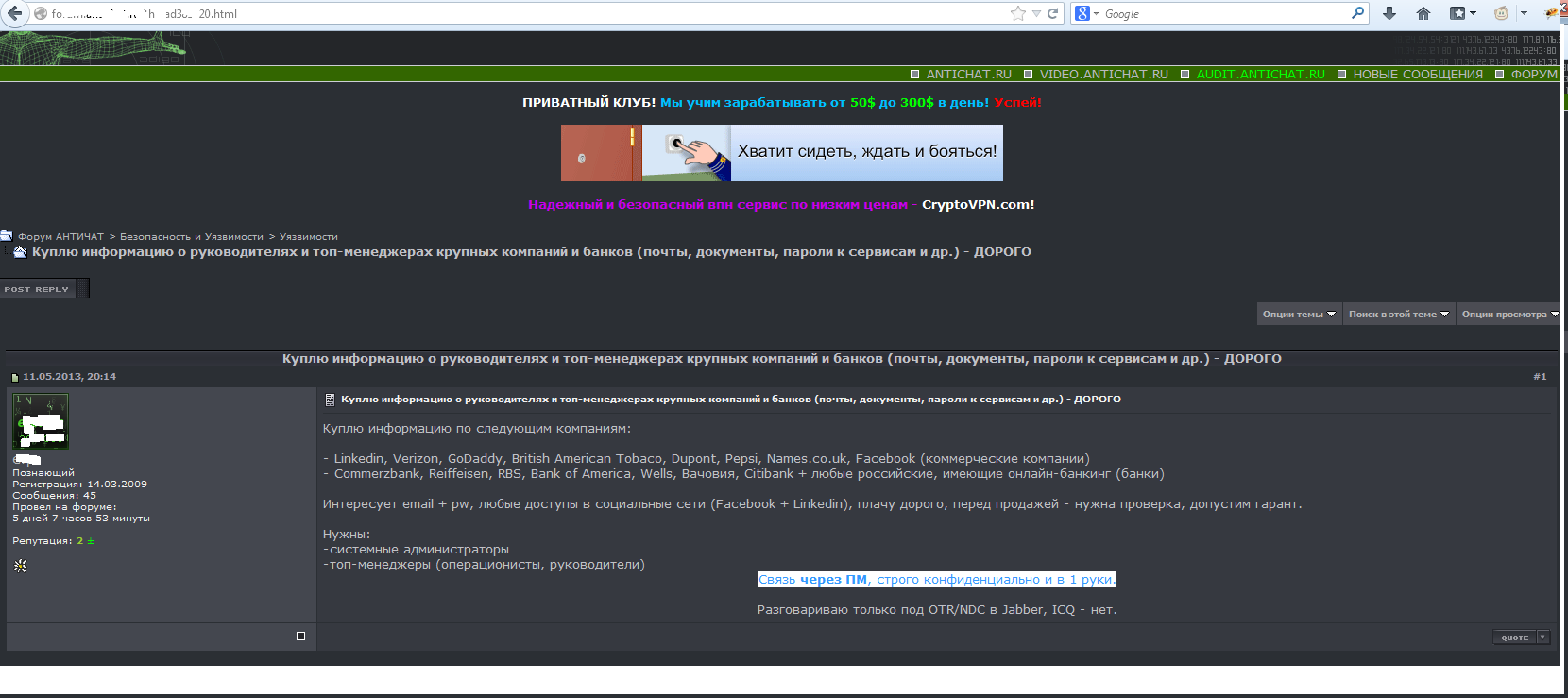
In the above image is reported a post from an underground forum that demonstrates the hacker’s interest to confidential data on CEO and top management of different well known brands, following the translation from Russian:
“Will buy information about the following companies:
- Linkedin, Verizon, GoDaddy, British American Tobaco, Dupont, Pepsi, Names.co.uk, Facebook (private companies)
- Commerzbank, Reiffeisen, RBS, Bank of America, Wells, Wachovia, Citibank + any russians, having online-banking
Interested in email + password, any stolen accounts of its employees in social networks (Facebook + Linkedin), will pay good, before selling need to have a garant and checking.
Interested in hacked accounts and data on:
- sustem administrators;
- top managers (operational managers, heads of the departments)
Reach me only through PM, confidential and in 1 hands
WIll talk only under OTR/NDC encryption in Jabber, don’t use ICQ “
Read More at http://goo.gl/LIcQR5
Subscribe to:
Comments (Atom)